Federal Reserve Shifts Gears: FOMC Raises Benchmark Rate by 25 Basis Points to Combat Persistent Inflation

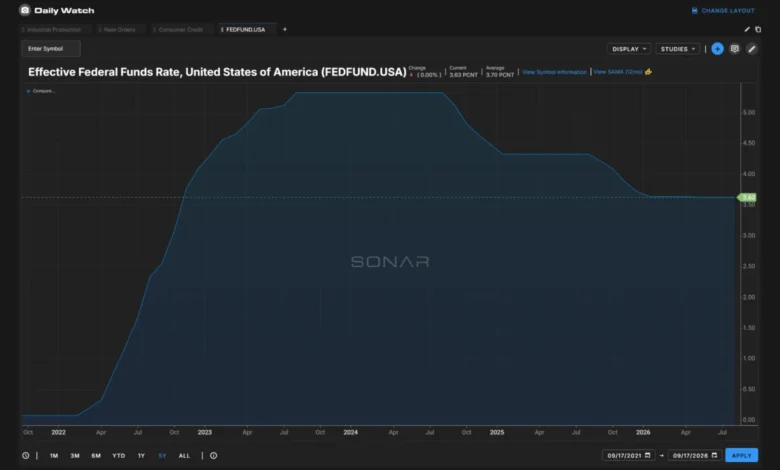
On September 16, the Federal Open Market Committee (FOMC) formally shifted its monetary policy stance, implementing a 25-basis-point increase to the federal funds target range, bringing it to 3.75%–4.00%. This adjustment marks the central bank’s first interest rate hike following a prolonged sequence of reductions designed to navigate economic volatility. Federal Reserve Chair Kevin Warsh characterized the policy pivot as a necessary response to persistent inflationary pressures, noting during post-meeting statements that inflation remains unacceptably high and has lingered above the central bank’s targets for too long.
Effective September 17, the central bank adjusted its comprehensive suite of administered rates in lockstep with the primary benchmark change. According to the implementation notes released by the Fed, the interest on reserve balances (IORB) rose from 3.65% to 3.90%, while the overnight reverse repo (ON RRP) rate increased from 3.50% to 3.75%. Furthermore, both the primary credit discount rate and the Standing Repo Facility (SRF) rate were elevated to 4.00%. For asset-heavy sectors—most notably the logistics and freight industries, which rely heavily on financed equipment, revolving credit lines, and fluid consumer demand—this policy reversal initiates a complex chain reaction across supply chains, borrowing costs, and operational capacity.
The Dual Mandate and the Mechanics of the FOMC
The foundational objectives guiding the Federal Reserve are established by Congress through a dual mandate: achieving price stability and maintaining maximum sustainable employment. The FOMC, which directs monetary policy, comprises 12 voting members. This panel includes the seven members of the Board of Governors alongside a rotating selection of five presidents from the 12 regional Federal Reserve Banks. The committee convenes approximately eight times annually to evaluate economic indicators and establish the target range for the federal funds rate—the benchmark interest rate that commercial institutions charge one another for overnight loans of reserves.
When economic indicators show inflation running above the Federal Reserve’s preferred 2% target, as measured by the Personal Consumption Expenditures (PCE) Price Index, while labor markets remain resilient, the dual mandate typically shifts its primary focus toward price stability. In this instance, FOMC leadership judged that subduing inflation outweighed the risk of applying moderate brakes to economic growth, setting the stage for the September rate increase.
Transmission Mechanism: From Target Range to Traded Rates
The FOMC does not dictate the federal funds rate directly. Instead, it sets a target range and employs a framework of four administered rates to anchor the actual market rate within those boundaries. This system is divided across mechanisms for traditional depository institutions and non-bank financial entities.
The IORB serves as the interest rate floor for commercial banks. Because financial institutions can earn a guaranteed, risk-free return of 3.90% directly from the Federal Reserve, they have no incentive to lend reserves to third parties overnight for a lesser yield. Conversely, the ON RRP rate acts as a parallel floor for non-bank financial entities that do not hold direct reserve accounts at the Fed. This group includes government-sponsored enterprises (GSEs) such as Fannie Mae and the Federal Home Loan Banks (FHLBs), prominent money market funds like Vanguard’s Treasury Money Market Fund and BlackRock’s Government Money Market Fund, and primary dealers including Goldman Sachs & Co. and J.P. Morgan Securities. The ON RRP facility guarantees these non-bank participants a risk-free overnight option yielding 3.75%, preventing liquidity from driving market rates below the intended floor outside the traditional banking sector.
On the upper boundary, the primary credit discount rate enables commercial banks to borrow directly from the Fed at 4.00% rather than paying exorbitant rates in private interbank markets during liquidity squeezes. Similarly, the Standing Repo Facility permits both depository institutions and primary dealers to secure short-term liquidity by pledging Treasury securities and agency debt as collateral at a 4.00% rate. Designed as a modern financial backstop, the SRF aims to prevent systemic liquidity crises and sudden credit freezes.
The practical metric observed by market participants on a daily basis is the effective federal funds rate (EFFR)—the volume-weighted median rate at which banks complete overnight transactions, published each business day by the Federal Reserve Bank of New York. The EFFR typically trades just below the IORB because certain active lenders, notably the FHLBs, are ineligible to earn IORB directly. Consequently, these lenders will accept slightly lower yields to deploy excess cash rather than letting capital sit idle. On the final full trading day preceding the September rate hike, the EFFR printed at 3.63%, positioning itself appropriately beneath the 3.65% IORB and within the previous 3.50%–3.75% target range. Following the latest adjustment, market analysts expect the EFFR to settle just beneath the newly established 3.90% IORB while maintaining a stable cushion above the 3.75% ON RRP floor.
Economic Foundations: Interest as the Price of Time
At its core, an interest rate represents the economic price of time preference—the financial compensation demanded by savers to forgo immediate access to their capital, and the cost incurred by borrowers for utilizing those funds ahead of time. In an unmanaged market, this price is determined within the framework of loanable funds, where the aggregate supply of savings meets the demand for investment and consumption capital, establishing an equilibrium market clearing rate.
While the Federal Reserve does not entirely dismantle the laws of supply and demand, it intervenes heavily at the short end of the yield curve by establishing risk-free returns via administered rates like the IORB and ON RRP. Because the entire broader term structure of credit—including benchmark Treasury yields, commercial mortgages, corporate commercial paper, and revolving consumer credit lines—prices off these short-term risk-free anchors, any movement by the FOMC immediately ripples through virtually every borrowing decision across the global economy.
Broader Economic Implications and Inflation Control
The economic transmission of a federal funds rate hike follows a well-established path. Higher policy rates directly increase the cost of funds for commercial financial institutions, a cost that is subsequently passed on to corporate and retail borrowers through elevated loan rates. As borrowing costs climb, the hurdle rate for capital investment and consumer consumption rises, naturally dampening aggregate demand.
Constraining credit growth against a near-term stable supply of goods and services relieves upward pressure on consumer prices. Furthermore, higher domestic interest rates tend to attract international capital seeking higher risk-free yields, strengthening the U.S. dollar. A stronger dollar subsequently lowers the domestic cost of imported goods and dollar-denominated commodities, providing an additional mechanism to combat energy-driven inflation spikes.
Operational Ripple Effects Across Logistics and Freight Markets
While macroeconomic policy decisions originate in Washington boardrooms, their operational consequences inevitably reach the physical supply chain and freight transportation sectors.
Higher interest rates directly increase the carrying costs associated with holding inventory. Consequently, commercial shippers are incentivized to transition toward leaner, more frequent replenishment schedules. While this shift can create short-term volatility and volume headwinds for carriers, it can also precipitate sharper freight market surges later as corporate inventory buffers are drawn down to minimal levels.
Rate-sensitive sectors, particularly residential housing and large durable goods manufacturing, typically experience the earliest downturns following monetary tightening. This cooling immediately impacts specialized logistics segments, dampening truckload demand for flatbed carriers hauling building materials and dry van volumes tied to appliance and furniture distribution.
On the supply side of transportation, commercial motor carriers seeking to finance heavy-duty tractors, dry vans, reefers, and warehouse automation technology face an escalated cost of capital. This higher financial hurdle frequently delays fleet modernization and capacity expansion plans. Such lagged tightening effects often materialize in spot market rate fluctuations long after the initial central bank announcement.
Thinly capitalized small-to-midsize carriers, which frequently rely on revolving credit lines to manage daily fuel floats and driver payrolls, bear the brunt of these monetary shifts earliest. Elevated financing costs often accelerate carrier market exits and revocations, driving structural capacity contractions that are historically characteristic of prolonged freight market troughs.
Meanwhile, the strengthening of the U.S. dollar yields mixed results for international intermodal, ocean, and cross-border freight segments. While a robust dollar makes imported consumer goods more affordable for domestic buyers—potentially supporting containerized import volumes—it simultaneously increases the relative cost of U.S. manufactured exports in international destination markets, creating offsetting pressures for outbound logistics providers.
As the Federal Reserve navigates its dual mandate through an evolving economic landscape, the disconnect in velocity between macroeconomic rate adjustments and long-term freight cycle shifts remains a critical consideration for industry operators planning capital expenditures, capacity allocations, and strategic supply chain frameworks over a multi-year horizon.